
Achieving consistent color in aerosol spray products requires much more than selecting the correct pigment shade. During storage, transportation, and application, pigments must remain evenly distributed inside the can to ensure that every spray delivers the expected color and finish.
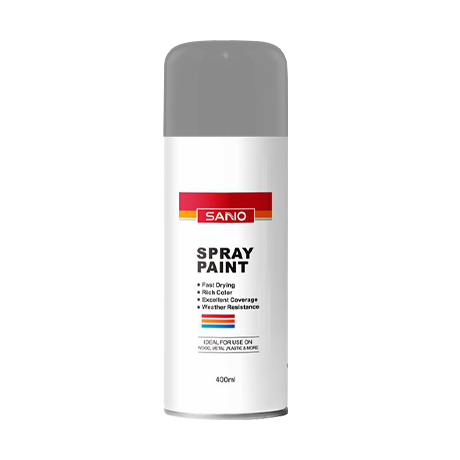
As a custom color spray paint manufacturer, SANVO understands that color variation often begins before the product reaches the user. If pigments are not properly stabilized inside the formulation, settling can affect spray performance, color accuracy, and overall coating appearance.
Pigment dispersion stability is therefore a critical factor in aerosol paint development. It affects whether a product can maintain reliable color performance throughout its storage period and application process.
Why Color Consistency Is Difficult to Maintain in Aerosol Systems
Aerosol spray paints contain multiple components that must work together, including pigments, binders, solvents, and functional additives. Each component influences how the coating behaves inside the can.
Pigments naturally tend to move because of differences in density between solid particles and the liquid coating medium. Without sufficient stabilization, heavier particles may gradually move downward and create uneven distribution.
The stability issue intensifies with customized colors, as many desired shades rely on blends of multiple pigments—each carrying distinct physical and chemical properties that complicate the task of keeping the mixture uniform throughout distribution and storage cycles.
Color matching should therefore be evaluated together with storage stability, because pigment settling during storage can affect the shade and appearance of subsequent sprays. SANVO’s formulation approach prioritizes this long-term reliability, designing custom aerosol paints that help maintain color consistency and dispersion stability throughout defined storage and application conditions.
The Impact of Pigment Compatibility on Color Stability
Different pigments do not always behave the same way when combined in an aerosol formulation. Some particles may interact well with the resin system, while others may have difficulty remaining evenly distributed.
Poor compatibility can cause pigment particles to attract each other and form larger clusters. These changes may influence color strength, surface smoothness, and spray appearance.
To prevent this issue, manufacturers evaluate how pigments interact with the complete coating system rather than selecting colors based only on visual matching.
A stable pigment system requires harmony between pigment characteristics and the surrounding formulation environment.
How Resin Systems Help Maintain Pigment Distribution
The resin system plays an important role in keeping pigments suspended inside aerosol cans. It provides the structure that surrounds pigment particles and influences how they move within the liquid.
A suitable resin system helps create a stable coating environment where pigments remain evenly distributed during storage.
However, resin selection must also consider application requirements. The coating needs to maintain good flow during spraying while preserving enough internal stability to prevent separation.
For custom colors, this balance becomes especially important because different pigment combinations may require adjustments to achieve both appearance and storage reliability.
Managing Color Accuracy During Custom Formulation Development
Custom color development involves more than reproducing a visual target. Manufacturers must ensure that the color remains consistent during production, filling, storage, and final application.
Small differences in pigment distribution can affect shade accuracy. This can become a concern for customers who require repeatable colors across multiple production batches.
During formulation development, manufacturers analyze pigment behavior and optimize the combination of raw materials to maintain stable color output.
A reliable custom color system allows users to achieve the expected appearance without noticeable differences between aerosol cans.
The Influence of Aerosol Storage Conditions on Pigment Stability
Before reaching the end user, aerosol products are subjected to a range of environmental and mechanical stresses—temperature fluctuations, transit vibration, and prolonged warehousing—all of which can compromise the internal stability of the paint if not adequately addressed in the formulation.
Even a coating that performs well immediately after production may exhibit undesirable changes after extended storage, particularly when pigment suspension systems are not carefully controlled to prevent settling or agglomeration.
That is why SANVO emphasizes long-term stability testing throughout its development process, evaluating how the complete coating system responds to real-world storage and transport conditions over time to ensure consistent performance from factory to final application.
Understanding storage behavior helps improve product reliability and ensures that pigment distribution remains consistent throughout the product lifecycle.
Production Control for Uniform Aerosol Color Performance
Maintaining pigment dispersion stability requires careful control during manufacturing. Mixing conditions, filling processes, and raw material consistency can all influence final product performance.
Even when the formulation is well designed, poor production control may create differences between batches.
Manufacturers need to maintain consistent processing conditions to ensure that each aerosol can contains a uniform coating system.
This production discipline supports better color repeatability and reduces the possibility of unexpected variations during customer use.
Improving Spray Results Through Stable Pigment Technology
Pigment dispersion stability affects more than color appearance. It also influences coverage, spray texture, and the overall quality of the finished coating.
When pigments remain evenly distributed, users can achieve more consistent results across different surfaces and applications.
From formulation design to production verification, SANVO‘s quality control practices support stable pigment performance for professional users who depend on reliable color matching. This is particularly important for repair work, industrial finishing, and customized projects, where appearance consistency is critical.
Conclusion
Pigment dispersion stability is a key factor in preventing color settling and maintaining consistent performance in aerosol cans. It influences color accuracy, storage reliability, and the final appearance of sprayed surfaces.
Achieving reliable custom color spray paint outcomes requires more than individual expertise in any single area—it demands seamless coordination across pigments, resin systems, formulation design, and manufacturing execution.
By controlling pigment behavior throughout the product lifecycle, manufacturers can provide aerosol coatings that deliver reliable color results from the first spray to the last.